Straight Talk on Fireplace Cleaning Passaic NJ: 2026 Guide for Glen Head Residents
Here is something we hear more than you might expect: a Glen Head homeowner searches online for fireplace cleaning, lands on results that mention fireplace cleaning Passaic NJ, and walks away with a pocketful of bad assumptions about how often cleaning is needed, who is qualified to do it, and what the whole process actually costs on Long Island. The misinformation floating around this topic is remarkable, and some of it is genuinely dangerous. We want to set the record straight.
Our team works throughout Nassau County Glen Head, Sea Cliff, Oyster Bay, Locust Valley, and beyond — and we have seen firsthand what happens when homeowners act on bad advice. Let us walk through the most common things people get wrong, and why it matters for your home and your family.
A Glen Head Homeowner Who Almost Skipped an Inspection
Last winter, a homeowner on one of Glen Head’s older residential streets called us after noticing a faint smoky smell when the wind shifted. She had purchased the house the previous spring and assumed the sellers had handled the chimney. They had not. A quick look inside the firebox revealed nearly a quarter inch of glazed creosote lining the flue — well past the threshold that warrants immediate attention. The National Fire Protection Association’s NFPA 211 standard specifies that solid-fuel-burning appliances and their associated chimneys must be cleaned when creosote deposit buildup exceeds 1/8 inch. Her buildup was roughly double that. One sweep and a follow-up chimney inspection later, she was burning safely. The whole situation traced back to one wrong assumption: that a recently sold home had a clean chimney.
What Homeowners Get Wrong About Credentials
The most persistent misconception we encounter is that any handyman or general contractor can clean a fireplace competently. People see a brush and a vacuum and think the skill ceiling is low. It is not. Proper fireplace cleaning requires knowledge of flue geometry, liner condition, draft dynamics, and creosote classification three distinct stages of creosote require three different removal approaches, and misidentifying the stage can mean incomplete cleaning or, worse, damage to the liner itself.
The Chimney Safety Institute of America (CSIA) maintains a national certification program specifically because this work demands structured training. When you are vetting a contractor — whether you found them searching for fireplace cleaning Passaic NJ or through a neighbour’s referral in Syosset ask directly whether their technicians hold CSIA Certified Chimney Sweep credentials. Ask for proof, not just an answer. A legitimate contractor will not hesitate.
We also run into homeowners who hired someone based on a low price alone. In Glen Head and across Nassau County, we have cleaned up behind contractors who left creosote behind, cracked flue tiles uncatalogued, and paperwork that amounted to nothing more than a receipt. The Chimney Safety Institute of America (CSIA) recommends that chimneys, fireplaces, and vents be inspected at least once per year, regardless of use frequency and that inspection needs to be documented properly, not just performed.
The Pricing Confusion That Gets People in Trouble
Another wrong assumption: fireplace cleaning should cost under a hundred dollars. In 2026, a thorough chimney sweep and Level 1 inspection in Nassau County typically runs between $175 and $275 for a standard single-flue fireplace, depending on access, liner type, and the degree of buildup. You will find outliers on both ends. What matters is understanding what you are paying for.
A contractor quoting $75 for a sweep is almost certainly skipping the inspection component, using inadequate containment (meaning soot in your living room), or planning to upsell aggressively once they are on site. We have heard this story from homeowners in Roslyn Harbor, Bayville, and Great Neck alike. The price that sounds too good is a red flag, not a bargain.
On the other end, be cautious of contractors who arrive, peer into the firebox briefly, and immediately quote thousands of dollars in repairs before completing the cleaning. A reputable company cleans first, documents what the inspection reveals, and then discusses any necessary repairs with you — showing you photographs from our chimney camera inspection service as evidence. You should never be pressured to approve major work on the spot.
Annual Cleaning Is Not Optional for Occasional Users
Many Glen Head homeowners burn wood only a handful of times each winter and conclude their chimney can go several years between cleanings. The logic seems sound — less use, less buildup. But this misses two things. First, even a few fires can produce meaningful creosote accumulation depending on wood moisture, fire temperature, and flue draft. Second, a chimney that sits largely unused is equally vulnerable to animal nesting, moisture intrusion, and mortar deterioration — none of which are detectable without a proper look inside.
According to the National Fire Protection Association (NFPA), heating equipment — including chimneys and fireplaces — is a leading cause of home fires in the United States, responsible for approximately 1 in 7 home fires annually. That statistic does not come with a footnote exempting light users.
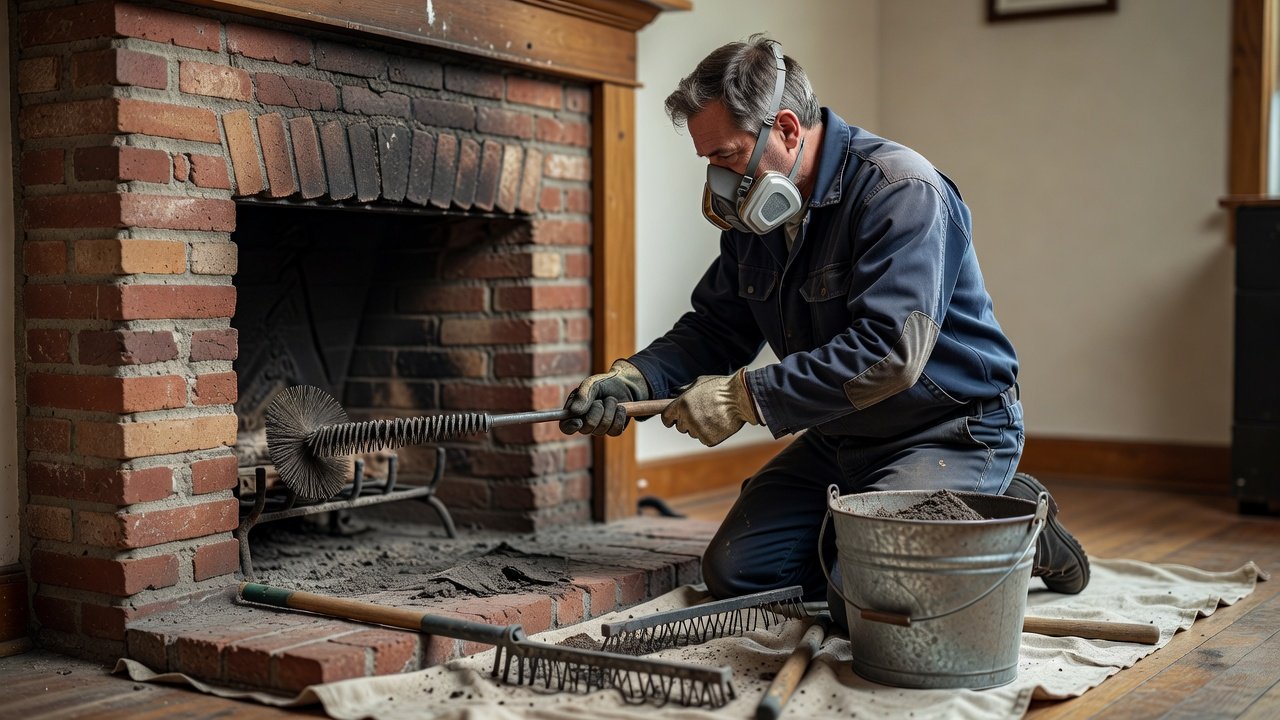
Annual service is also where good contractors add real value beyond a brush pass. Our technicians check the damper operation, examine the firebox for spalling brick or cracked mortar, look at the chimney cap and crown condition, and assess the liner. On Long Island’s North Shore, where salt air and repeated freeze-thaw cycles through January and February put unusual stress on masonry, that annual check catches problems while they are still inexpensive to fix.
Questions That Separate Good Contractors from the Rest
Before you book anyone for fireplace cleaning whether you found them through a search for fireplace cleaning Passaic NJ or a local referral — ask these four things. Do your technicians carry CSIA certification? Will the sweep include a documented Level 1 inspection? How do you handle containment and cleanup inside the home? And can you show me photos of what you find before recommending repairs?
A contractor who answers all four cleanly and confidently is worth booking. One who deflects, rushes you, or cannot produce documentation is not no matter how competitive the price.
We serve Glen Head and the surrounding Nassau County communities, and we are happy to walk through any of these questions before you commit to a single dollar. Reach out through our website contact form to request a free estimate and let our team take a look.
Frequently Asked Questions About Fireplace Cleaning on Long Island
How often should a fireplace in Glen Head be cleaned?
At minimum, once per year — and before the first fire of each heating season. The CSIA recommends annual inspection and cleaning regardless of how frequently you use the fireplace. Glen Head’s coastal climate accelerates mortar and liner wear, so consistent annual service catches problems early.
What should a fireplace cleaning cost in Nassau County in 2026?
A thorough sweep with a Level 1 inspection typically falls between $175 and $275 for a standard single-flue system in Nassau County. Quotes significantly below that range usually signal skipped steps or poor containment practices.
What does CSIA certification actually mean for a chimney sweep?
CSIA-certified sweeps have passed a standardised exam covering chimney systems, fire codes, inspection procedures, and safe cleaning practices. It is the primary professional credential in the industry and the one you should verify before hiring any contractor.
Why does creosote buildup matter so much?
Creosote is combustible. The NFPA reports that creosote buildup is the leading cause of chimney fires, with failure to clean being cited in the vast majority of chimney fire incidents. Even a modest accumulation can ignite under the right conditions, and glazed third-stage creosote is particularly difficult and dangerous to remove.
Is a video camera inspection necessary, or is it a sales tactic?
For most annual cleanings a visual Level 1 inspection is appropriate. A Level 2 inspection — which includes video scanning of the flue — is required by CSIA standards whenever a home changes ownership or after any event that may have caused chimney damage, such as a chimney fire or severe storm. If a contractor recommends it outside those situations, ask why.
What red flags should I watch for when hiring a chimney sweep?
Unusually low flat-rate quotes, pressure to approve expensive repairs before the cleaning is complete, no documentation of inspection findings, and inability to show CSIA credentials are the four we see most often. Any one of them is reason to look elsewhere.
Related from Chimney Glen Cove: Fireplace Damper Repair Passaic in Glen Cove · Fireplace Damper Repair Passaic in Glen Cove · Fireplace Damper Repair Passaic Glen Cove
Our services
Fireplace Damper Repair Passaic in Glen Cove · Fireplace Damper Repair Passaic in Glen Cove · Fireplace Damper Repair Passaic in Glen Cove · Fireplace Damper Repair Passaic in Glen Cove · Fireplace Damper Repair Passaic Glen Cove · Fireplace Damper Repair Passaic in Glen Cove
Areas we serve
Plainview, NY · Port Washington, NY · Northport, NY · Commack, NY · Smithtown, NY · Melville, NY · Locust Valley, NY · Glen Head, NY