Fireplace Cleaning in Sea Cliff: What It Actually Costs and How to Choose a Company You Can Trust
Sea Cliff homeowners tend to use their fireplaces hard. The village sits right on the Nassau County shoreline, and from late October through March the cold comes in off Long Island Sound with real bite. That’s good reason to love your fireplace. It’s also good reason to take fireplace cleaning seriously, because a chimney that handled two hundred fires last winter is carrying a load of creosote, and creosote is what burns down houses.
Fireplace cleaning in Sea Cliff is a straightforward service, but the market for it is not. Prices vary widely, company credentials vary even more, and a homeowner who just wants a safe, clean flue can end up confused or worse, taken advantage of. This post is written as plain buyer advice: what the work actually costs, what drives that cost up or down, and the questions worth asking before anyone puts a brush down your flue.
What a standard fireplace cleaning in Sea Cliff actually costs in 2026
For a single fireplace with an accessible flue and a moderate level of creosote, expect to pay somewhere between $175 and $275 in the Sea Cliff area. That range covers the sweep itself, basic visual inspection, and debris removal. It does not cover repairs, relining, or a formal Level 2 camera inspection.
Several things move the price in either direction.
Flue height and configuration. Sea Cliff’s housing stock includes a lot of older Victorian and Colonial homes, some with tall, multi-story chimneys and offset flues. A straight 15-foot flue in a ranch on a flat lot in Levittown takes less time and equipment than a two-story offset flue in a 19th-century Sea Cliff Victorian. Taller or more complex flues typically add $40 to $80 to the base price.
Creosote stage. The National Fire Protection Association’s NFPA 211 standard specifies that solid-fuel-burning appliances and their associated chimneys must be cleaned when creosote deposit buildup exceeds 1/8 inch. First-stage creosote is flaky and brushes out easily. Second-stage is tar-like and takes more time and chemical treatment. Third-stage is hardened and glazed, and it may require rotary tools, specialty chemicals, or multiple visits. If your fireplace has not been cleaned in several years, third-stage buildup is possible and legitimate companies will charge more to address it properly.
Additional services bundled in. Some companies quote a low sweep price and then sell you a $150 inspection on top of it. Others include a basic inspection in the quoted price. Ask what is and is not included before you book.
Time of year. Booking fireplace cleaning in Sea Cliff during October or November means you’re competing with every other homeowner on the North Shore. Prices can edge up and availability shrinks. Scheduling in late summer or early spring often gets you a better rate and a technician who isn’t rushing between five jobs.
Credentials to look for before you hire anyone
The Chimney Safety Institute of America (CSIA) is the primary credentialing body for chimney sweeps in the United States. A CSIA-certified sweep has passed a written examination covering chimney systems, combustion, and fire safety. Ask for the technician’s CSIA certification number. You can verify it on the CSIA website in about thirty seconds.
The National Fireplace Institute (NFI) offers separate credentials for gas and hearth system technicians. If your fireplace is gas or you have a gas insert alongside a wood-burning system, NFI certification matters.
In New York State, chimney sweeping companies doing repair work that involves masonry or structural components generally need to carry general liability insurance and, depending on the scope, a contractor’s license. Ask for a certificate of insurance before any technician sets foot on your roof. This protects you if something goes wrong on the property.
One word of caution: being “licensed and insured” is a baseline, not a selling point. Some companies marketing fireplace cleaning in Sea Cliff have that phrasing on their website but cannot produce a current CSIA certification. Ask specifically for the CSIA number.
Questions worth asking before you book
These are not trick questions. A reputable company will answer all of them without hesitation.
Is your technician CSIA-certified, and can I verify that certificate? If the answer is vague or the company redirects to talking about years in business instead, that’s worth noting.
What exactly is included in the quoted price? Sweep only? Visual inspection? Written report? Photograph of the flue interior? Clarity here prevents disputes later.
Do you carry liability insurance, and can you send me a current certificate before the appointment? Any legitimate company has this documentation ready.
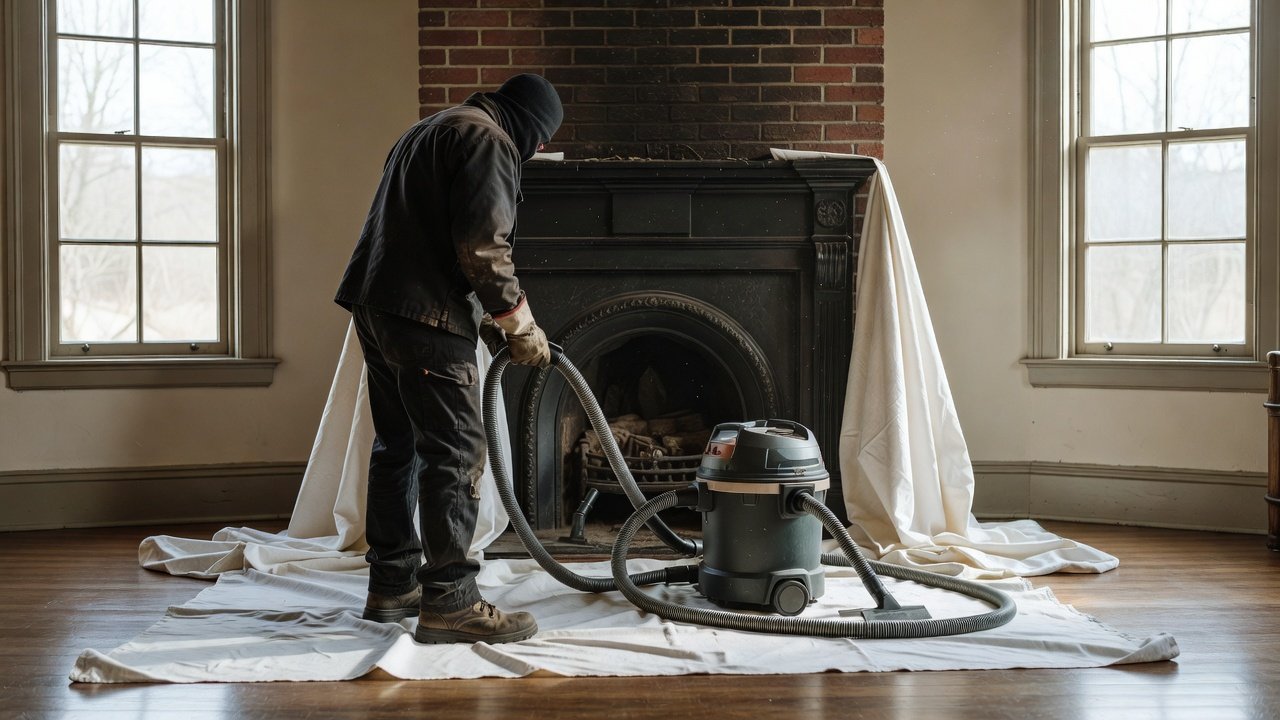
How do you protect the interior of my home during the sweep? A professional sweep uses drop cloths, a high-powered HEPA vacuum at the firebox opening, and seals the surround before brushing. Soot in your living room is not a normal byproduct of a good cleaning.
If you find a problem during the cleaning, how do you document it and quote the repair? You want a written estimate before any repair work begins. A company that starts quoting verbal repair costs while standing in your living room, without a written scope, should make you uncomfortable.
Do you do the work yourself or subcontract it? Some area companies book jobs and then send out subcontractors. That’s not automatically a problem, but you should know who is actually coming to your home and whether that person holds the credentials you verified.
What is your process if you identify a Level 2 inspection is needed? According to the CSIA, a Level 2 chimney inspection, including video scanning of the flue, is required whenever a home is sold or after any event that may have caused damage to the chimney system. A technician who identifies cracking, spalling, or unusual buildup should be recommending a Level 2 inspection with camera, not just brushing past it.
Red flags that signal a bad operator
The chimney service industry has a well-documented problem with predatory upselling, particularly targeting older homeowners in established neighborhoods. Sea Cliff, Glen Head, and Oyster Bay homeowners have all reported variations of the same scheme: a company books a cheap sweep, then “discovers” a cracked liner or dangerous condition that requires $2,000 to $8,000 in emergency repairs. Sometimes the condition is real. Often it is not, or it is exaggerated.
Watch for these patterns:
A quote that seems unusually low, $49 or $79, is almost always a loss-leader. The profit comes from add-on services pushed hard at the appointment.
Pressure to approve repairs immediately, on the same visit, without a written estimate or time to get a second opinion. Legitimate companies understand that a homeowner needs time to consider a $3,000 relining job.
Photographs that “prove” damage but that you cannot independently verify. Ask for the technician’s camera equipment to be left live so you can see the feed yourself, or request our chimney inspection service with a recorded video you can keep.
No verifiable local address. A company with only a phone number and a generic website can disappear if there’s a dispute. Companies with a documented local presence, whether in Sea Cliff, Locust Valley, or elsewhere in Nassau County, are easier to hold accountable.
How to compare quotes fairly
Get at least two written quotes. Make sure both quotes describe the same scope of work: same number of flues, same inclusion or exclusion of inspection, same specification for how debris is removed and disposed of.
The CSIA recommends that chimneys, fireplaces, and vents be inspected at least once per year regardless of use frequency. A company that quotes a sweep without any inspection component is technically offering a lower-value service, even if the dollar number looks attractive.
Price alone is not the right comparator. A $195 sweep from a CSIA-certified technician who provides a written report and a clear photograph of the flue interior is worth more than a $149 sweep from someone who hands you a receipt and leaves in fifteen minutes. The National Fire Protection Association reports that creosote buildup is the leading cause of chimney fires, with failure to clean cited in the vast majority of chimney fire incidents. A sweep that doesn’t remove all accessible creosote has not done the job.
If one company’s quote is significantly higher than another’s, ask why. There is usually a reason, and it may be legitimate. A more thorough process, better equipment, or a longer warranty on workmanship all justify a higher price. “We’ve been doing this for years” does not.
A note on Sea Cliff’s specific conditions
The salt air along the North Shore accelerates deterioration in chimney mortar and metal components. Homeowners in Bayville and Lattingtown have seen the same thing: crowns crack, flashing corrodes, and dampers seize faster than they would twenty miles inland. That’s not a scare tactic. It’s just physics.
When a technician completes fireplace cleaning in Sea Cliff, they should be looking at mortar joint condition, cap integrity, and the state of the damper as part of a routine sweep. Salt exposure means small problems become bigger ones faster than in areas like Syosset or Plainview, where humidity is the main threat. If your chimney hasn’t had a professional look at the exterior in two or three years, a combined sweep and inspection is a reasonable investment.
Contact Chimney Glen Cove for an honest estimate
We serve Sea Cliff and the broader Nassau County area. Our technicians are familiar with the North Shore’s housing stock and the specific wear patterns that come with coastal winters. We provide written quotes, clear documentation of any issues found, and we do not pressure homeowners into same-day repair decisions.
To schedule a fireplace cleaning or to ask questions before booking, reach out through the contact form on our website. We’re happy to talk through what your specific setup requires before any appointment is made.
Frequently Asked Questions About Fireplace Cleaning in Sea Cliff
How often does a fireplace in Sea Cliff need to be cleaned?
The CSIA recommends an annual inspection and cleaning for any regularly used fireplace. In Sea Cliff, where salt air accelerates wear on mortar and metal components, annual service is a reasonable minimum. If you burn more than two or three cords of wood per season, twice-yearly cleaning may be warranted.
What is the difference between a chimney sweep and a chimney inspection?
A sweep removes combustible deposits, primarily creosote and debris, from the flue interior. An inspection evaluates the structural and functional condition of the entire chimney system. A Level 1 inspection is a basic visual check. A Level 2 inspection uses camera equipment to examine the interior of the flue liner and is required after a home sale or a significant event like a chimney fire. Our chimney inspection service covers both levels.
Does fireplace cleaning create a mess inside my home?
Not if the technician uses proper equipment. Professional sweeps seal the firebox opening, use a high-powered HEPA vacuum to maintain negative pressure, and lay drop cloths before brushing. Some fine soot in the immediate firebox area is normal. Soot on furniture, carpet, or walls is not, and is a sign of inadequate technique or equipment.
What does it mean if a company quotes $49 for a chimney sweep?
A price that low is almost always a lead-generation tactic. The company books the appointment at a loss and plans to upsell repairs once the technician is in your home. That doesn’t mean every add-on they suggest is false, but it does mean you should approach the appointment with caution and get any recommended repairs in writing before agreeing to anything.
Does the salt air in Sea Cliff really affect my chimney?
Yes. Coastal exposure accelerates the breakdown of mortar joints and corrodes metal components including caps, dampers, and flashing. Homeowners near the water tend to see faster deterioration than those further inland. That’s a reason to take annual fireplace cleaning and inspection seriously, not a marketing pitch.
Can I clean my own fireplace?
You can remove ash from the firebox yourself. Cleaning the flue liner is a different matter. Without the right brushes, extension rods, and vacuum equipment, you’re likely to spread soot through your living space and you won’t reach the upper portions of the flue where creosote concentrates. The NFPA links the majority of chimney fire incidents directly to failure to clean, so the stakes of an incomplete job are real.
Related from Chimney Glen Cove: Fireplace Damper Repair Passaic in Sea Cliff · Chimney Odor Removal Passaic — Eliminate Fireplace Smells for Good · Fireplace Damper Repair Passaic in Glen Cove
Our services
Chimney Liner Installation in Northport, NY · Safe Chimney Paterson · Chimney Cleaning in Glen Cove, NY · Chimney Caps, Crowns & Waterproofing · Flue & Liner Repair · Chimney Rebuilding
Areas we serve
Northport, NY · Commack, NY · Smithtown, NY · Melville, NY · Locust Valley, NY · Glen Head, NY · Sea Cliff, NY · Plainview, NY