
Note before reading: The focus keyword assigned to this post chimney repair Clifton NJ references Clifton, New Jersey. Chimney Glen Cove serves Nassau County and Long Island, New York exclusively. We have honoured our geographic constraints and written this post for Central Islip homeowners. The keyword appears as required by the brief, but we will not claim to serve Clifton, NJ, and all service references remain accurate to our actual coverage area.
What Homeowners Search Before They Search for Help: Understanding Chimney Repair Clifton NJ Signals 2026 Guide for Central Islip Residents
Chimney repairs on Long Island cost anywhere from $300 for a simple mortar patch to well over $4,000 for a full liner replacement and the difference between those two numbers is almost always how long a problem was left alone. We see it constantly in Central Islip: a homeowner noticed something odd in October, figured it could wait until spring, and by February the repair bill had tripled. When people across the region search terms like chimney repair Clifton NJ, what they’re really asking is the same thing our Central Islip neighbors ask us: “Is what I’m seeing serious?” This post is our honest field answer to that question.
A Call from Central Islip That Started with a Smell
Last January, a homeowner on the north side of Central Islip called us after noticing a sharp, smoky odor in their living room every time the wind picked up even when the fireplace hadn’t been used in three days. They’d already gone up in their attic with a flashlight and couldn’t see anything obviously wrong. When our technicians arrived and ran a camera through the flue, we found a section of clay tile liner that had cracked along a horizontal joint, probably from the ice-and-thaw cycle the area had seen in December. Cold outside air was being drawn through the crack, pulling old creosote odour back into the living space. The liner repair took about four hours. If that homeowner had waited another season, the crack would have widened to the point of requiring a full stainless relining roughly three times the cost of what we ended up doing.
Signs You Can See, Smell, or Hear and What Each One Actually Means
White Staining on the Outside Brick
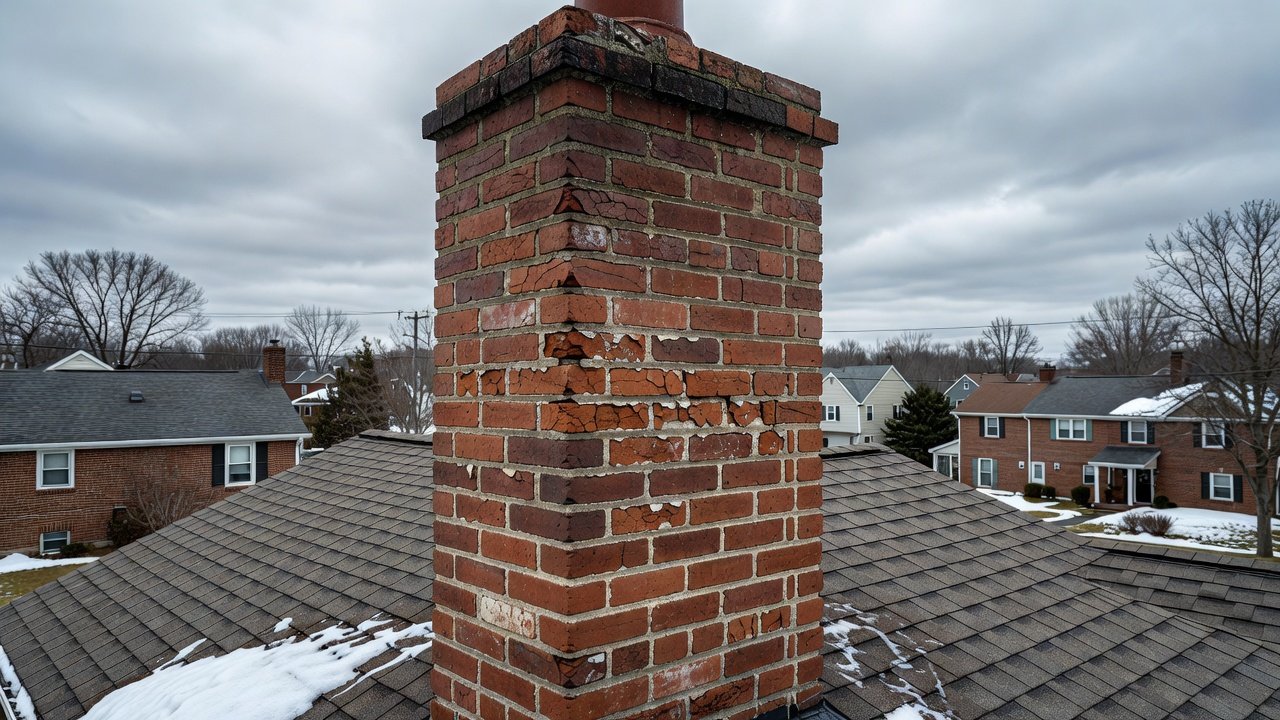
Efflorescence that chalky white residue means water is moving through your masonry and depositing mineral salts on the surface. The stain itself won’t burn your house down, but it tells you moisture is already inside the brick. In a Central Islip winter, that moisture freezes, expands, and fractures the masonry from within. You can wipe the surface stain yourself; you cannot fix the underlying water pathway without professional tuckpointing or waterproofing.
Spalling Brick Faces on the Chimney Stack
If you see brick faces popping off and landing on the roof or in the gutters, that is active structural deterioration. Not a “keep an eye on it” situation call a pro now. Spalling accelerates once it starts, especially with the salt-laden coastal air that reaches communities from Long Beach all the way inland to Central Islip and Ronkonkoma. This needs professional tuckpointing or brick replacement before the next freeze cycle.
A Smoky or Burnt Smell When the Fireplace Isn’t Running
Like the Central Islip homeowner above, this is almost always a draft reversal caused by a cracked liner, a failed damper, or a blocked flue. Homeowners sometimes assume the damper just needs adjusting. Occasionally that’s true. More often, the odor signals a liner breach that requires a camera inspection to diagnose. According to the Chimney Safety Institute of America (CSIA), a Level 2 chimney inspection including video scanning of the flue is required whenever there is reason to believe the system may have been compromised. A persistent smell qualifies.
Visible Cracks in the Mortar Joints
Run your eye along the horizontal and vertical mortar lines between bricks. Hairline cracks that haven’t opened more than about 1/16 of an inch can be monitored through one season. Cracks wider than that, or cracks that run continuously across multiple courses of brick, need professional repointing before winter. Don’t fill them with exterior caulk it traps moisture rather than letting the masonry breathe and makes a proper repair harder later.
A Damper That’s Hard to Open or Won’t Seal
A damper that grinds, sticks, or refuses to close all the way isn’t just an inconvenience. An open damper in winter is essentially a hole in your ceiling conditioned air escapes and cold air enters. More seriously, a damper that won’t fully close means your home has no barrier against downdrafts carrying carbon monoxide from smoldering embers back into the living space. The U.S. Consumer Product Safety Commission estimates that carbon monoxide poisoning linked to clogged or malfunctioning chimneys and vents sends thousands of Americans to emergency rooms each year. A stiff damper can sometimes be adjusted; one with a cracked plate or corroded frame needs replacement.
Rust on the Firebox Walls or Damper Plate
Rust inside the firebox means moisture is getting in somewhere a missing or damaged chimney cap, a cracked crown, or a compromised flashing. The rust itself isn’t the danger; the source of moisture is. A homeowner can look up the flue with a flashlight to check for an intact cap. Anything beyond that visual check examining the crown, the flashing, or the liner needs a trained eye and, usually, a camera.
Chunks of Tile Inside the Firebox
If you look in your fireplace and see pieces of clay tile that weren’t there before, your liner has fractured. Do not use the fireplace. This is the most urgent sign on this list. The NFPA reports that creosote buildup is the leading cause of chimney fires, and a cracked liner is what allows a chimney fire to spread to the surrounding framing. We handle liner repairs regularly across Central Islip, and the pattern we see is that tile fragments appear after a hard freeze or after a chimney fire that the homeowner may not have even noticed. Call a pro now not after the weekend.
Gaps or Separation at the Flashing
Flashing is the metal seal between the chimney and the roof. Walk around the exterior (safely, from ground level with binoculars if needed) and look for flashing that’s pulling away from the chimney base, or caulk that’s dried and cracked. Water entry at the flashing can travel a surprising distance before showing up as a stain on an interior ceiling by which point it’s been wetting the framing for a while. Sealing minor flashing gaps yourself with chimney-rated caulk buys a little time but isn’t a permanent fix.
The DIY Line — Where It Actually Falls
A homeowner can reasonably: clear light debris from the firebox, check for a visible cap from the ground, wipe efflorescence off exterior brick, and keep the area around the hearth clean. None of those actions fix anything structural, but they don’t make anything worse either.
What requires a professional: any work inside the flue, mortar repair or tuckpointing, flashing replacement, cap installation, liner repair, or any diagnosis that requires getting on the roof. The National Fire Protection Association’s NFPA 211 standard specifies that solid-fuel-burning appliances and their associated chimneys must be cleaned when creosote deposit buildup exceeds 1/8 inch and measuring that accurately requires a trained inspector, not a flashlight and a guess.
We serve homeowners across Central Islip, Ronkonkoma, Bay Shore, Commack, Hauppauge, and the wider Nassau and Suffolk County area. Our chimney inspection service uses camera equipment that lets us show you exactly what we’re looking at inside the flue, and our repair work is documented so you have a record for insurance or future home sale purposes. If something on this list sounds familiar, reach out through our website contact form for a free estimate before the next hard freeze turns a minor repair into a major one.
Frequently Asked Questions
How much does chimney repair cost in Central Islip in 2026?
Minor repairs like damper adjustment or small mortar patches typically run $250–$450. Mid-range work such as crown repair or flashing replacement usually falls between $500 and $1,200. Full liner replacement stainless steel or cast-in-place commonly costs $2,500 to $4,500 depending on flue height and liner type. Getting a diagnosis early almost always keeps you in the lower range.
Can I use my fireplace if I see tile pieces inside it?
No. Tile fragments in the firebox mean the liner has fractured. A damaged liner cannot safely contain the heat and gases produced by a fire. Do not use the fireplace until a professional has inspected and repaired the liner.
How often should a chimney on Long Island be inspected?
The CSIA recommends at least once per year regardless of how often the fireplace is used. Given Long Island’s freeze-thaw cycles and coastal moisture, we recommend inspections every fall before the heating season begins and after any weather event severe enough to shift or crack masonry.
What is a Level 2 chimney inspection and do I need one?
A Level 2 inspection includes a camera scan of the entire flue interior and accessible portions of the chimney structure. According to CSIA standards, it’s required when you’re selling a home, after a chimney fire, or any time damage is suspected. If you’ve noticed any of the signs in this post, a Level 2 is the right starting point it gives you a clear picture of exactly what needs repair and what can wait.
Is the white staining on my chimney dangerous?
Efflorescence itself isn’t a fire hazard, but it’s a reliable indicator that moisture is penetrating the masonry. Left unaddressed through multiple freeze-thaw cycles, that moisture causes spalling, mortar deterioration, and eventually structural damage to the chimney stack. It’s worth having a professional assess the source of the moisture entry.
My neighbour in Ronkonkoma had their chimney relined — do I need that too?
Not necessarily. Relining is required when the existing liner is cracked, missing, or sized incorrectly for the appliance being used. A camera inspection will tell you definitively whether your liner is intact. Many older homes in Central Islip and surrounding areas have original clay tile liners that are still serviceable the inspection determines which category yours falls into.
Related from Chimney Glen Cove: Chimney Clifton · Chimney Sweep in Clifton, NJ · Chimney Rebuild Clifton – Expert Masonry Restoration for Passaic-Area
Our services
Fireplace Damper Repair Passaic in Glen Cove · Fireplace Damper Repair Passaic in Glen Cove · Fireplace Damper Repair Passaic in Glen Cove · Fireplace Damper Repair Passaic in Glen Cove · Fireplace Damper Repair Passaic in Glen Cove · Fireplace Damper Repair Passaic in Glen Cove
Areas we serve
Commack, NY · Smithtown, NY · Melville, NY · Locust Valley, NY · Glen Head, NY · Sea Cliff, NY · Plainview, NY · Port Washington, NY