What Most Homeowners Get Wrong About Home Park Clifton: 2026 Guide for West Islip Residents
Most of the calls we get about Home Park Clifton systems come in December. By then, the damage is already done, and the repair bill reflects it. The common assumption is that you inspect the chimney when something goes wrong. We’d argue the opposite: the problems we find in winter were almost always diagnosable in September, when fixing them would have cost a fraction of what emergency work runs in peak season.
West Islip sits close enough to the Great South Bay that its homes deal with salt-laden air, hard coastal winters, and freeze-thaw cycles that are genuinely punishing on masonry. Home Park Clifton chimney systems in this area age differently than systems ten miles inland and diagnosing them requires knowing what to look for, not just looking.
A Real Situation from Down the Road
Last October, a homeowner in Lindenhurst called us after noticing a faint smoky smell in their living room. They assumed a bird had built a nest in the flue over the summer a reasonable guess. When our technicians arrived, the nest was real, but it wasn’t the whole story. A horizontal crack had formed in the smoke chamber, and the blockage had been forcing exhaust to find alternative paths through the masonry. By the time we were done with the full diagnostic, the homeowner was looking at a smoke chamber repair, a flue reline, and a new cap work that, had the crack been caught in August during a routine sweep, would have been limited to a single repair at roughly half the combined cost. They’re using their fireplace safely this season. But they’ll tell you themselves: call earlier.
Six Problems We Actually Find and How We Diagnose Them
1. Creosote Buildup Beyond the Safe Threshold
Symptoms: A dark, tar-like odor from the firebox, reduced draw, or visible black glazing on the damper. Homeowners often assume the smell is normal. It isn’t. The National Fire Protection Association’s NFPA 211 standard specifies that solid-fuel-burning appliances and their associated chimneys must be cleaned when creosote deposit buildup exceeds 1/8 inch. In West Islip homes with older, narrower flues — common in the mid-century housing stock throughout this area — that threshold gets crossed faster than most people expect, especially after a winter of burning green or mixed wood.
The fix: A professional sweep using rotary brush systems and HEPA-filtered vacuum equipment. For Stage 2 or 3 glazed creosote, chemical treatments precede the mechanical cleaning. Prevention is straightforward: burn only seasoned hardwood and schedule your sweep before the first fire of the season, not after.
2. Spalling Mortar and Freeze-Thaw Joint Failure
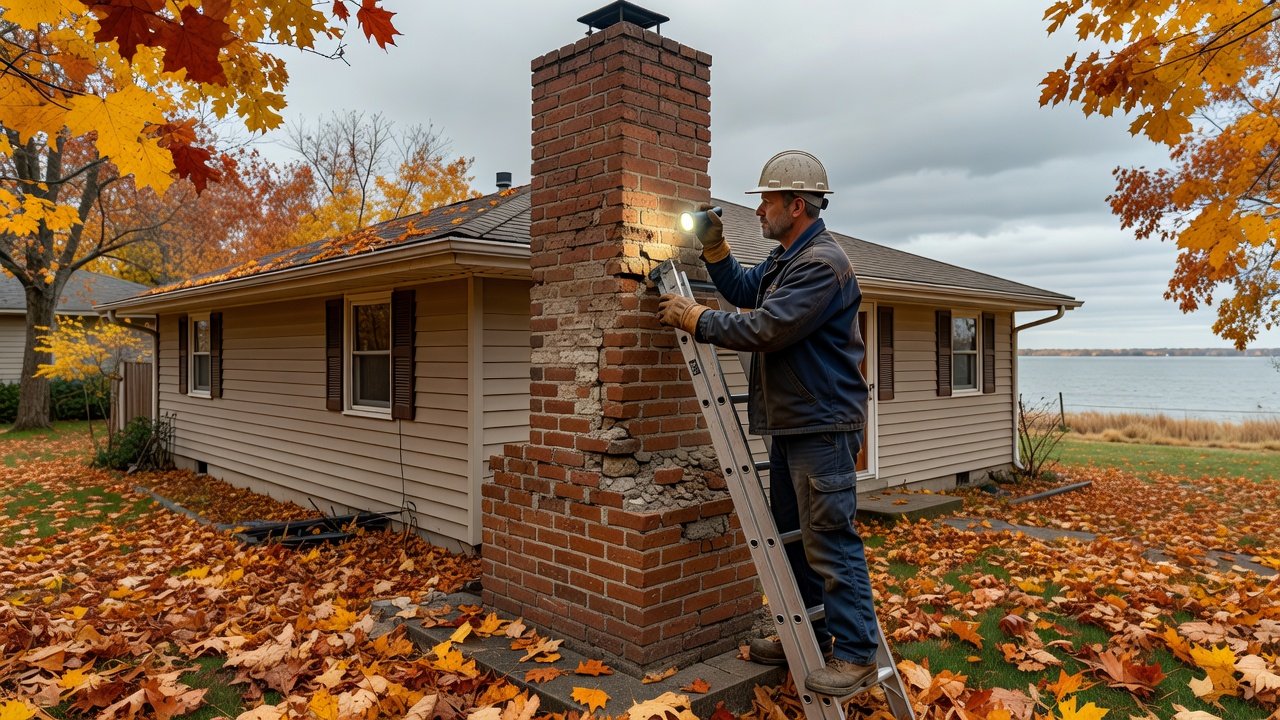
Symptoms: White mineral staining (efflorescence) on the exterior stack, crumbling mortar joints, or small brick fragments on the roof or in the firebox. Our coastal Long Island climate runs homeowners through dozens of freeze-thaw cycles between November and March. Water penetrates micro-cracks, freezes, expands, and opens the crack wider each cycle.
The fix: Tuckpointing, which means removing degraded mortar to a consistent depth and packing new, properly mixed refractory mortar. A good tuckpoint job done in fall before the first hard freeze bonds correctly. The same job attempted in January, when temperatures are below 40°F, requires heat tenting and extended cure times, adding labor cost. We see this on chimneys throughout Amityville and West Islip repeatedly.
3. Cracked or Collapsed Flue Tiles
Symptoms: Unusual odors, visible debris in the firebox, or a recent chimney fire even a small one. This one rarely announces itself loudly. According to the Chimney Safety Institute of America (CSIA), a Level 2 chimney inspection including video scanning of the flue is required whenever a home is sold or after any event that may have caused damage to the chimney system. We find cracked tiles frequently on chimneys that had a small, fast-burning event the homeowner dismissed as a brief “whoosh” sound years earlier.
The fix: Camera inspection first, always. Depending on severity, repairs range from individual tile replacement to a full stainless-steel liner installation. This is the problem where waiting has the steepest cost — a cracked liner that allows combustion gases into wall cavities is a carbon monoxide and structural fire risk simultaneously. Our chimney camera inspection service is how we confirm what we’re actually dealing with before we recommend any repair path.
4. Damaged or Missing Chimney Caps
Symptoms: Animal intrusions, water in the firebox after rain, or rust staining on the damper. A missing cap is one of the most common findings on homes we visit in Babylon and the surrounding South Shore communities. It’s also one of the least expensive problems to solve when caught before it causes secondary damage.
The fix: Cap replacement, sized correctly to the flue dimensions. A cap that’s too large or too small creates downdraft problems. We measure, source the appropriate stainless or copper cap, and seal the crown at the same visit. Left unaddressed through winter, a capless chimney can funnel enough water to rust out a steel damper and saturate the smoke shelf, turning a $200 fix into a $900 one. Our chimney caps and waterproofing service covers both the cap installation and crown sealing in a single visit.
5. Damper Failure — Stuck Open or Stuck Closed
Symptoms: Cold drafts entering the home when the fireplace isn’t in use (stuck open), or a firebox that fills with smoke when you try to light a fire (stuck closed or severely warped). Coastal humidity accelerates rust on throat dampers, and the salt air in waterfront communities like Bayville and Long Beach makes this worse than average. West Islip sees its share of it too.
The fix: Throat damper replacement, or in many cases, installation of a top-mount damper which also doubles as a cap and eliminates the corrosion problem going forward. Diagnosis requires hands-on inspection; a damper that appears to open may only be opening partially, restricting airflow enough to make the fireplace smoky and inefficient without ever completely failing.
6. Smoke Chamber Deterioration
Symptoms: Smoke entering the room even with the damper fully open, streaking on the firebox walls above the opening, or a visible corbeled brick surface that looks rougher than it should. The smoke chamber is the most aerodynamically critical part of the system and the most often overlooked. Rough or deteriorating surfaces create turbulence that disrupts the draft and traps combustion gases.
The fix: Smoke chamber parging applying a smooth, insulating refractory coating over the interior surface. This is typically a half-day job when we have clear access. Catching it before it progresses to structural deterioration of the chamber walls keeps it in that category. Ignore it and the chamber walls eventually need rebuilding, which is a multi-day masonry project. We recommend pairing this with our chimney inspection service so we can assess the full system in one visit.
What Waiting Actually Costs in 2026
We’re direct about this with every homeowner we talk to. Fall sweeps and inspections in our area typically run between $150 and $250 for a standard Level 1 inspection and sweep. A Level 2 inspection with camera is usually $250 to $400. Repairs caught at that stage tuckpointing, cap replacement, damper work commonly run $200 to $600 each.
The same calls in December, when we’re booked weeks out and working in 28-degree weather, take longer, cost more to execute safely, and sometimes have to be phased because certain materials can’t be applied in extreme cold. Emergency calls get prioritized but priced accordingly. The homeowners who call us in Oyster Bay or Merrick in August pay less and wait less. That’s not a promotional line it’s just what the numbers show year after year.
The NFPA reports that creosote buildup is the leading cause of chimney fires, and failure to clean is cited in the vast majority of incidents. We’d add failure to clean on time is equally responsible. The fire risk doesn’t wait for a convenient booking window.
Ready to Get Ahead of It?
Our technicians serve West Islip and the surrounding South Shore and Nassau County communities. If you’re not sure what condition your Home Park Clifton system is in, that uncertainty itself is reason enough to book. Use our website contact form to request a free estimate we’ll tell you exactly what we find, what it means, and what it will cost to fix it properly before winter tightens up your schedule and your budget.
Frequently Asked Questions About Home Park Clifton in West Islip
What is a Home Park Clifton chimney system and why does it need special attention on Long Island?
Home Park Clifton refers to a specific chimney system type commonly found in the mid-century residential housing stock across Nassau and Suffolk County communities. Long Island’s coastal climate salt air, humidity, and repeated freeze-thaw cycles accelerate the deterioration of mortar joints, flue liners, and damper hardware compared to more inland regions. West Islip’s proximity to the Great South Bay makes these conditions particularly relevant for homeowners there.
How often should a Home Park Clifton system be inspected?
The Chimney Safety Institute of America (CSIA) recommends that chimneys, fireplaces, and vents be inspected at least once per year, regardless of use frequency. For homes in West Islip and the surrounding South Shore communities, we recommend scheduling that inspection in late summer or early fall before heating season so any repairs can be completed in favorable weather conditions.
What are the early warning signs that something is wrong with my chimney before winter?
Watch for efflorescence (white mineral staining) on the exterior stack, mortar dust or small brick chips in the firebox, a smoky or sulfur-like odor when the fireplace isn’t in use, visible rust on the damper plate, or animals entering through the top of the chimney. Any one of these warrants a professional inspection, not a wait-and-see approach.
Is a chimney camera inspection always necessary?
Not for every situation, but it is the only reliable way to evaluate the interior condition of a flue liner. For any home that has experienced a chimney fire, a change in draw behavior, or an unexplained odor, a Level 2 video inspection is the standard. The CSIA also requires it when a home changes ownership. We offer this as a standalone service or combined with a sweep.
How much does chimney repair typically cost in West Islip in 2026?
Costs vary by the scope and timing of the work. Basic sweeps and inspections generally run between $150 and $400. Targeted repairs — tuckpointing, cap replacement, damper work typically fall between $200 and $700 per item when caught early. Flue relining or smoke chamber rebuilds are more significant investments, often ranging from $1,500 to $4,000 or more depending on the flue length and access conditions. Booking in fall rather than mid-winter consistently yields better pricing and faster scheduling.
Can I use my fireplace while waiting for a repair appointment?
It depends entirely on what the problem is. A damaged flue liner or smoke chamber crack is a reason to suspend fireplace use until repairs are complete combustion gases escaping into wall cavities are a carbon monoxide and fire risk. A worn mortar joint or missing cap is serious but may allow limited use in specific conditions. We give homeowners a clear, specific answer after the inspection not a blanket prohibition or blanket clearance.
Related from Chimney Glen Cove: Chimney Clifton · Chimney Sweep in Clifton, NJ · Chimney Rebuild Clifton – Expert Masonry Restoration for Passaic-Area
Our services
Chimney Repair · Chimney Cleaning · Fireplace Damper Repair Passaic in Glen Head · Fireplace Damper Repair Passaic in Glen Head · Fireplace Damper Repair Passaic in Sea Cliff · Fireplace Damper Repair Passaic in Glen Cove
Areas we serve
Locust Valley, NY · Glen Head, NY · Sea Cliff, NY · Plainview, NY · Port Washington, NY · Northport, NY · Commack, NY · Smithtown, NY