Creosote Removal in Smithtown, NY
If you are searching for trusted Creosote Removal in Smithtown, Chimney Glen Cove is your nearby, certified answer. We serve Smithtown homeowners from the tree-lined streets near Caleb Smith State Park Preserve to the older colonial neighborhoods off Route 25A with professional creosote removal that meets current NFPA 211 standards and genuinely protects your home from chimney fire.
Creosote is not a minor housekeeping issue. It is a combustible tar-like compound that coats the inside of your flue every time you burn wood. Left unaddressed, even a modest buildup can ignite at temperatures exceeding 2,000°F hot enough to crack clay tile liners, warp steel flue liners, and spread fire into adjacent wood framing. Our Smithtown crews remove all three stages of creosote accumulation, leaving your flue clean, inspected, and documented before we leave your driveway.
Why Smithtown Homeowners Face a Higher Creosote Risk
Smithtown sits in central Suffolk County on Long Island, where a combination of local conditions creates an above-average environment for rapid creosote buildup:
- Cold, damp winters off the Nissequogue River corridor: The Nissequogue River winds through Smithtown before emptying into the Long Island Sound. Riverside and near-water properties particularly in the Landing Road and Edgewood Avenue areas experience consistently high humidity in the flue during transitional seasons. Moisture-laden smoke condenses faster on cold masonry walls, depositing sticky Stage 2 tar creosote at a rate faster than properties in drier inland climates.
- Abundant hardwood and softwood mix from local tree canopy: Smithtown’s residential streets and wooded lots near Blydenburgh County Park and Caleb Smith State Park Preserve mean many homeowners burn a mix of oak, maple, and more problematically pine and other softwoods. Softwood and unseasoned hardwood produce two to three times more creosote per cord than properly seasoned hardwood alone.
- Older housing stock with undersized or deteriorating flues: Many Smithtown neighborhoods including historic sections along Main Street near Smithtown Branch of the Long Island Railroad and the Lawrence Hill Road area feature homes built in the 1950s through 1970s. These chimneys were designed for oil and gas appliances, not modern wood-burning inserts. Retrofitted fireplace inserts in undersized flues run cooler, causing more unburned particulate to condense on the liner.
- Extended heating season use: Smithtown averages roughly 5,400 heating degree days per year. Residents who rely on a fireplace or wood stove as supplemental heat from October through April are burning 40 to 60 fires per season enough to deposit measurable Stage 2 or Stage 3 glazed creosote in a single year if a Level 1 cleaning is skipped.
Our Creosote Removal Process for Smithtown Properties
Chimney Glen Cove does not offer a one-size-fits-all sweep. Before we touch a brush or chemical applicator, we conduct a visual or video inspection to classify your creosote by stage:
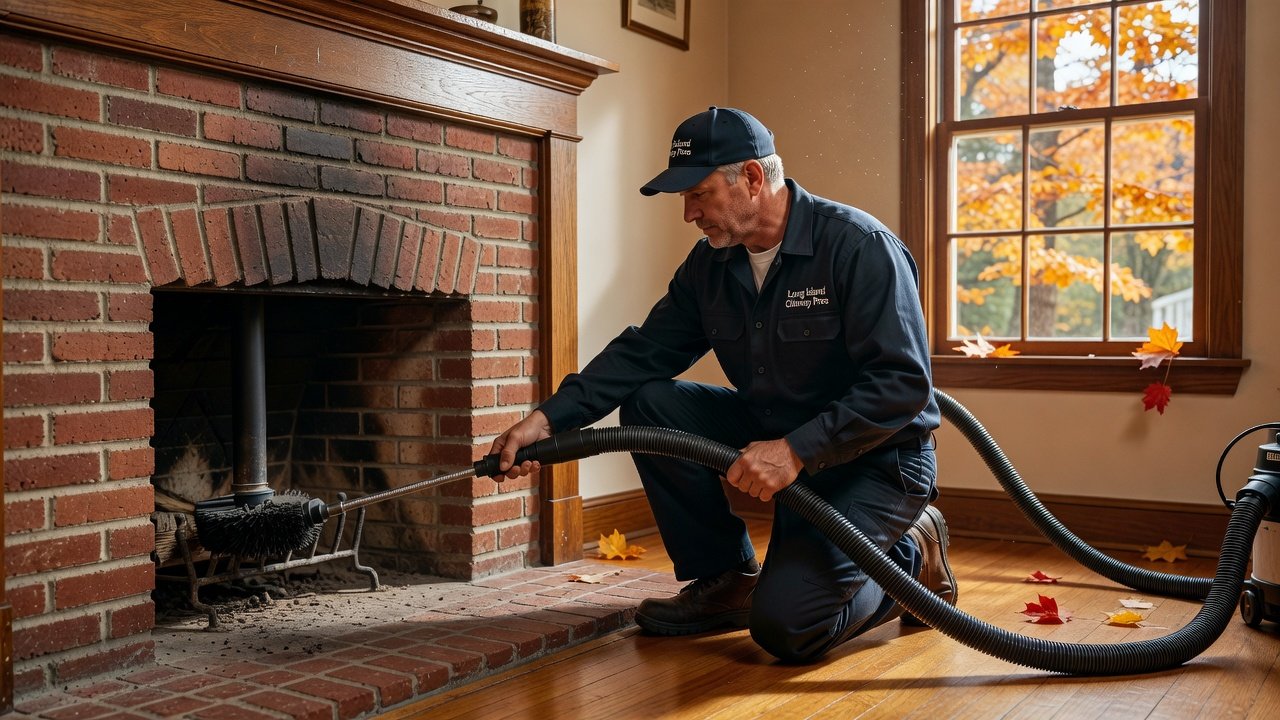
- Stage 1 — Dusty soot and light flake deposits: Removed with professional rotary brush systems fitted to your exact flue dimensions (6-inch round to 13×13-inch clay tile). Negative-pressure HEPA vacuums contain all debris inside your home. Typical service time on a Smithtown single-story ranch: 45 to 75 minutes.
- Stage 2 — Tar, shiny flakes, and crunchy layered creosote: Requires power rotary cleaning tools and, in many cases, a chemical pre-treatment with a professional-grade creosote remover catalyst (e.g., ACS or Poultice Creosote Remover). We apply the catalyst, allow appropriate dwell time, and then re-brush for complete removal. This is the stage most commonly found in Smithtown homes that were last cleaned two or more seasons ago.
- Stage 3 — Glazed, hardened, poured creosote: The most dangerous stage. Glazed creosote bonds to masonry and steel like a ceramic coating. Our crew applies a professional-grade Stage 3 chemical stripper (typically a chloride-free oxidizing compound), revisits the flue after the cure period, then power-brushes to remove loosened material. In severe cases which we occasionally encounter in older Kings Park and Nesconset homes with infrequently serviced fireplace inserts partial or full relining may be recommended after removal.
Every creosote removal appointment includes a written Level 1 inspection report. If we identify cracked tiles, deteriorated mortar joints, or a damaged damper, we document it with photographs and provide a written repair estimate no pressure, no surprises.
Serving Smithtown and Surrounding Suffolk County Communities
Chimney Glen Cove is based in the greater Long Island area and dispatches certified technicians directly to Smithtown and its surrounding neighborhoods. We are not a call-center franchise routing your job to an unknown subcontractor you get the same trained crew, carrying the same truck-mounted HEPA equipment, on every visit.
Primary service area includes:
- Smithtown (hamlet and incorporated village area, ZIP 11787)
- Kings Park (ZIP 11754) — including estates and colonials near St. Johnland Road
- Nesconset (ZIP 11767) — including neighborhoods bordering Lake Ronkonkoma
- Hauppauge (ZIP 11788) — particularly older residential areas north of Veterans Memorial Highway
- Commack (ZIP 11725)
- Saint James (ZIP 11780) — including homes near the Deepwells Farm County Historic Park area
- Stony Brook (ZIP 11790) — including properties near the Stony Brook University corridor
- Centereach and Lake Grove (ZIP 11720 / 11755)
- Head of the Harbor and Fort Salonga surrounding areas
If your address is in central or northwest Suffolk County and you are not sure whether we cover your street, call us. We rarely say no to a nearby neighbor in need of safe chimney service.
What Sets Chimney Glen Cove Apart for Smithtown Creosote Jobs
- NFPA 211-trained technicians who understand the specific failure modes of Long Island masonry chimneys built during the mid-century construction boom.
- Truck-mounted HEPA vacuum systems — no shop vacs, no dust left behind on your Smithtown living room furniture.
- Transparent, stage-based pricing. Stage 1 and Stage 2 cleanings are quoted upfront. Stage 3 glazed-creosote removal is quoted after our inspection because the severity varies widely. You approve every step before we proceed.
- Same-week appointments available for most Smithtown addresses — important if you have an upcoming home sale inspection, a real estate closing requirement, or a concern after smelling smoke in your living space.
- Documented service record provided after every visit, useful for homeowners insurance renewals and real estate disclosures common in Suffolk County transactions.
Frequently Asked Questions About Creosote Removal in Smithtown
How often does a Smithtown wood-burning fireplace need creosote removal?
The Chimney Safety Institute of America (CSIA) and NFPA 211 both recommend at minimum one professional cleaning and inspection per year for any fireplace or wood stove in active use. Given Smithtown’s longer heating season and the prevalence of mixed or partially seasoned wood among local homeowners, many of our Smithtown clients benefit from a mid-season check after roughly 30 fires particularly if they notice a stronger-than-usual smoke odor inside the room, which is a reliable early indicator of Stage 2 buildup. If your fireplace is decorative and you burn fewer than 5 fires per year, an annual Level 1 inspection without full cleaning may be sufficient, and we will tell you that honestly when we arrive.
I live near the Nissequogue River in Smithtown — does river humidity really make my creosote situation worse?
Yes, measurably so. Properties within roughly half a mile of the Nissequogue River corridor including areas near Landing Avenue, Moriches Road, and the river access points off New Mill Road experience ambient relative humidity that is consistently 8 to 15 percent higher than properties three or more miles inland during shoulder seasons (October–November and March–April). A colder, more humid flue causes combustion gases to condense at a higher point in the chimney, depositing wet, sticky tar-stage creosote rather than the drier, more easily brushed flake creosote found in drier environments. We account for this when selecting our cleaning method and chemical pre-treatments for riverside Smithtown addresses.
Can Chimney Glen Cove handle Stage 3 glazed creosote in the older fireplace inserts common in Kings Park and Nesconset homes?
Yes. Stage 3 glazed creosote is our most technically demanding service, and it is also one of the most common findings in the retrofit wood-burning inserts installed in Kings Park and Nesconset homes built between 1955 and 1980. These homes frequently had their original oil-fired boiler flue reconfigured to accept a wood stove insert a setup that runs cool and promotes rapid glazing. Our crew uses a professional-grade oxidizing chemical stripper, allows full cure time (typically 12 to 24 hours between applications), returns for a follow-up power brush, and then conducts a post-removal video inspection. If the liner itself has been damaged by previous glazed creosote fires a common finding, we will provide a written relining estimate using either a stainless-steel liner system or an appropriate castable resurfacing product sized for your specific flue.
Schedule Your Creosote Removal in Smithtown Today
Do not wait for a chimney fire warning sign. Creosote removal is one of the most direct, affordable steps a Smithtown homeowner can take to prevent a house fire and keep heating costs under control. Whether your fireplace has not been touched in three seasons or you simply want the peace of mind of a documented clean flue before the next heating season, our team is ready to help.
Call Chimney Glen Cove now or use our online booking form to request a same-week appointment in Smithtown, Kings Park, Nesconset, or any surrounding Suffolk County community. Our technicians answer your questions directly no call centers, no runaround. A safer chimney is one phone call away.
Our services
Chimney Cleaning in Syosset · Chimney Inspection in Great Neck · Fireplace Damper Repair in Huntington · Chimney Liner Installation in Northport, NY · Safe Chimney Paterson · Chimney Cleaning in Glen Cove, NY
Areas we serve
Sea Cliff, NY · Plainview, NY · Port Washington, NY · Northport, NY · Commack, NY · Melville, NY · Locust Valley, NY · Glen Head, NY